

Ash Silver WPC exterior wall cladding in a silvered-timber grey
The grey of weathered timber, with a silver sheen in the grain rather than a flat painted grey.
- Value
- Light to mid
- Colour temperature
- Cool grey
- Profiles
- 178 × 15 / 223 × 25 mm
- Warranty
- 10 years
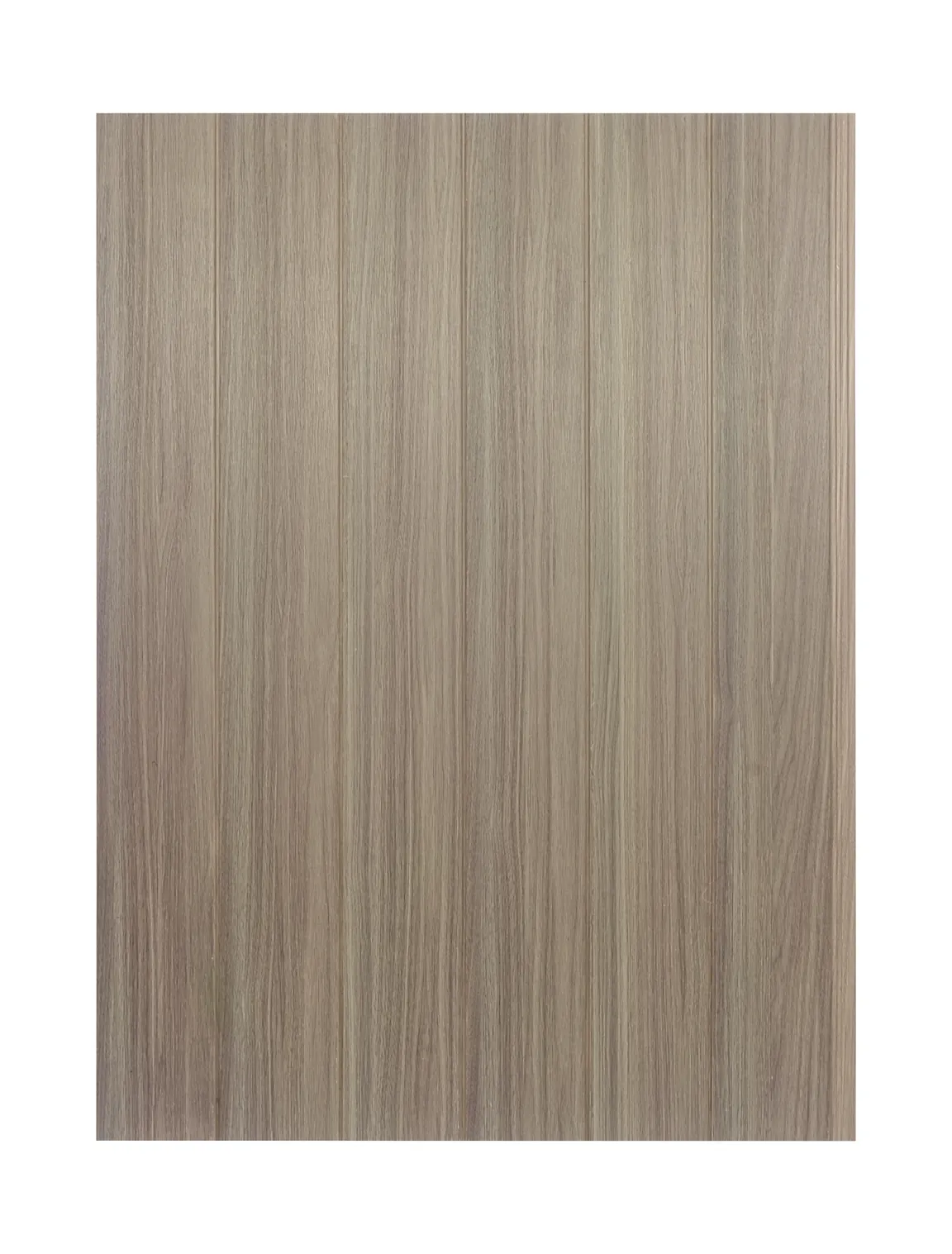
Photographs of the actual boards in this colour. Tap any swatch to move through the range.
Where Ash Silver sits in the six.
| Colour | Value | Temperature |
|---|---|---|
 Pale Oak Pale Oak | Lightest | Cool neutral |
 Ash Silver ← you are here Ash Silver ← you are here | Light to mid | Cool grey |
 Golden Beech Golden Beech | Light to mid | Warm golden |
 Honey Teak Honey Teak | Mid | Warm honey |
 Smoke Grey Smoke Grey | Mid to dark | Warm grey |
 Coffee Walnut Coffee Walnut | Darkest | Warm dark |
Three distances, three different colours.
The same board reads differently at arm's length, in the hand and from across the street. Look at all three before you decide — most disappointments with a timber-effect facade come from judging only one of them.
The surface you touch
A cool grey-taupe ground carrying a faint silver sheen along the brushed grain. The pore lines read a shade darker and cooler than the ground, so the figure shows as fine parallel striations rather than as a colour pattern.
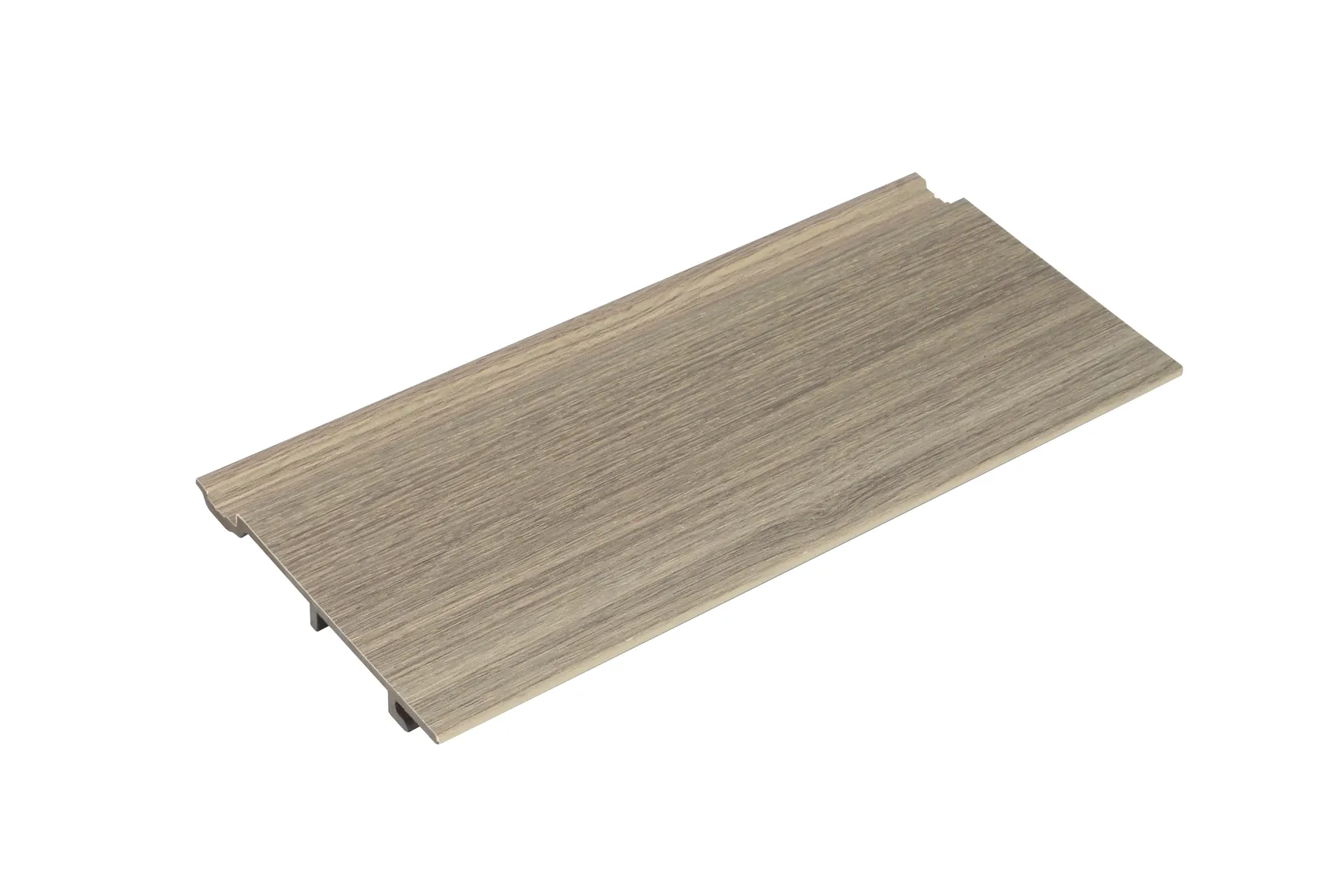
The board in your hand
A single Ash Silver board against the light. The sheen runs along the length of the brushed grain and is not visible straight on - turn the board and it appears, turn it back and it drops out. That behaviour is the difference between a silvered-timber grey and a flat painted one, and it is the reason to judge this colour at an angle rather than face-on.
The wall at twenty metres
The same boards installed. At this distance the joints stay visible as fine dark lines and the field reads as grey-stained timber rather than as a painted panel. That residual contrast is what gives a long elevation a measurable rhythm instead of a blank surface.
How Ash Silver behaves as the light changes.
No tone in the range depends more on the light it is standing in than this one. There is very little chroma in the surface to begin with, so there is very little for a change of light to leave alone.
At arm's length
A cool grey-taupe ground carrying a faint silver sheen along the brushed grain. The pore lines read a shade darker and cooler than the ground, so the figure shows as fine parallel striations rather than as a colour pattern.
As the light moves
This is the tone that changes most between sun and overcast, because it carries the least chroma in the range — there is almost no colour there to lose. Direct sun brings the warm grey forward; under cloud it goes close to neutral. Set it next to a warm render and it will read cool; set it next to a blue-grey wall and it will read warm. That is normal for a low-chroma grey and worth knowing before you fix the trim colour.
At twenty metres
At twenty metres it reads as grey-stained timber rather than as a painted panel. The board joints stay visible as fine dark lines, which gives a long elevation a measurable rhythm instead of a blank surface.

Six real sections, one lighting setup — the only honest way to compare two tones.
Horizontal or vertical
The grain runs along the board, so rotating the layout through 90 degrees rotates the figure with it, and changes the elevation more than the colour does. Horizontal boards make an elevation read wider and lower; vertical boards make it read taller. Decide it before the lengths are ordered.
In depth: Ash Silver.
Silvered timber, not painted grey - where the sheen comes from
Flat, even grey paint and plastic decking have between them given grey timber-effect products a bad reputation, and the thing that separates Ash Silver from both is not the colour. It is the brushed grain, which runs along the length of the board in the same direction as the timber it stands in for, plus the sheen that sits on top of it and only appears when you change your viewing angle to the surface. Straight on, the board is matte. Turn it against the light and a faint silver comes up out of the grain.
Practical consequence: judge this colour at an angle, not face-on, and do it on a wall rather than on a table. A sample lying flat under an office ceiling light will read flatter and cooler than the same board fixed to a vertical surface outdoors. If you are specifying grey because the brief says weathered timber or silvered decking, this is the tone; if it says painted grey, it is not.
The lowest-chroma tone in the range - and what that does to your trim colour
Ash Silver carries the least colour of the six. There is almost no chroma in it to lose, which is why it changes more between direct sun and overcast sky than any other tone here: the sun brings the warm grey forward and the cloud takes it back toward neutral.
The other half of a low-chroma surface is that it takes its reading from its neighbours. Put it next to a warm sand render and the cladding will read cool; put it next to a blue-grey wall or a zinc roof and the same board will read warm. This is normal, it is not a fault, and it is worth knowing before the trim is fixed - because once the frames, the fascia and the render are chosen, the cladding's apparent temperature has been decided for it. Look at the sample in the context it will actually live in.
A coastal specification: the board is not the weak point
On a sea-facing elevation the thing that fails first is almost never the cladding face. It is the fixings. Chlorides attack screws, brackets and batten connections well before they mark a composite surface, and the reason is simply that the fixings are metal and the cladding is not. So a coastal specification is written around three things: stainless or appropriately coated fixings, a drained and ventilated cavity behind the board so the wall can dry, and a wash-down regime agreed with the client rather than left to chance.
The surface itself is covered by three reports already on file - the 3000 h QUA ageing report for the ASA surface (SDHL2407013318HI), a water absorption report (SDHL2408014917HI) and a freeze / thaw report (SDHL250601030601HI). Copies are linked further down this page. They describe the surface system the boards are made from; the fixing detail for your project is still a project decision.
Where this tone family is already specified.
Ash Silver is read here against the grey group in our project file.
| Market | What the project file records |
|---|---|
| AustraliaOceania | Dark grey wall cladding, and SP-WP14 dark grey + IPE wall and deck |
| CanadaNorth America | SP-WP14 black with a custom walnut tone |
| SerbiaEurope | Black wall cladding project set |
| Costa RicaCentral America | SP-WP03 in antique smoke white, the lightest tone in the file |
How to read that table for Ash Silver
Ash Silver is read here against two records. The grey group appears in Australia (dark grey cladding, and a dark grey plus IPE wall-and-deck project), Canada (a black facade with a custom walnut tone) and Serbia (a black cladding project set). The light group appears in Costa Rica, the lightest tone in the whole file. The grey direction is therefore well represented in the file; the specific silvered-timber end of it is thinner, and the honest way to read the table is as evidence that the grey family is specified in those markets rather than as a count of silver-grey installations.
Every row above is a folder in the project photo file for the MexyTech co-extruded wall system that FV01 and FV02 are engineered on. It is not a claim that these installations used FV01 or FV02. The ledger records the profile and the market, not the pigmentation code, so the rows are grouped by tone family.
Where Ash Silver is used.
Coastal and salt-air elevations
The grey direction is the conventional answer where a timber look is wanted but a warm one would fight the sea light.
Contemporary gable ends
The low chroma lets a large unbroken triangle of wall sit without dominating.
Soffits and eaves
Keeps the underside reading as shadow without going black.
Garages, annexes, outbuildings
Where the cladding is a background plane to a main volume.
Boundary walls
A grey wall is read as structure, not as a feature, which is usually what a boundary wants.
Modern additions to older buildings
Reads as a deliberate contrast to brick or stone rather than as an imitation of it.
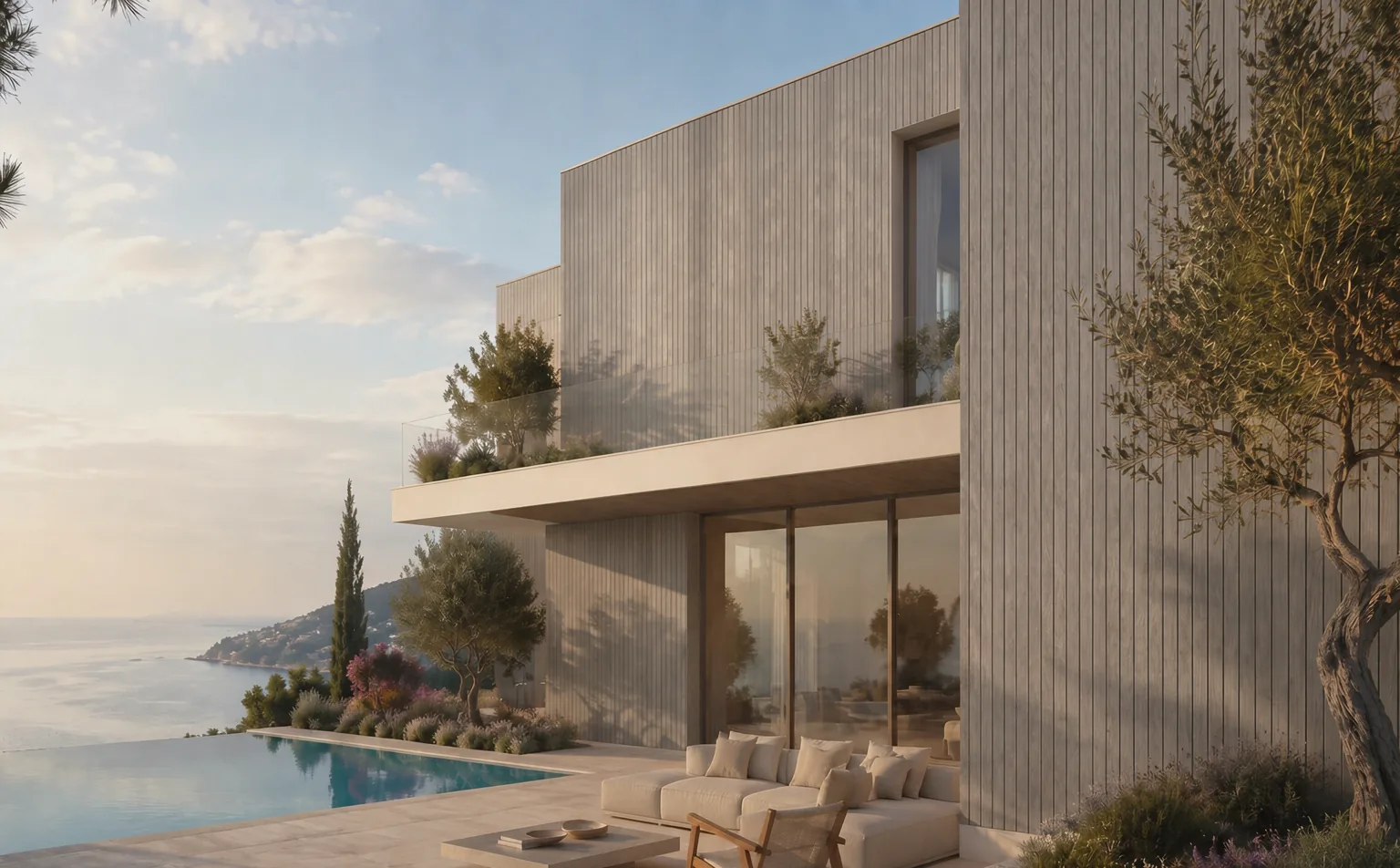
Concept visualisation: the same elevation with a cool silver-grey cladding, for comparison against the warm tones on the other colour pages. This is a design impression, not a photograph of an installed FlowVeins project.

The section is the argument: a fourth-generation WPC core, a composite ASA surface cured into it, and an interlocking edge that takes the screw without a visible fixing.
What Ash Silver sits beside.
Pale Oak for a soft step within the greys and creams; Coffee Walnut for the strongest non-coloured contrast. Outside the range: black steel, board-formed concrete, glass balustrades, zinc and grey stone.
Specification.
The surface tone is the only variable. The board underneath, the fixing detail and the warranty are the same as every other colour in the range - including the two greys either side of this one.
| Profiles | FV01 178 x 15 mm · FV02 223 x 25 mm |
|---|---|
| Exposed face | FV01 150 mm · FV02 195 mm |
| Construction | Fourth-generation WPC core with a composite ASA surface, cured together in the molecular crystal curing stage |
| Fixing | Patented pre-punched male end, screw-fixed to battens |
| Length | 2.9 m standard, custom within 3.0 m |
| Colours | Six standard colours, combinable in one container load |
| Warranty | 10 years, coverage scope subject to the formal warranty statement |
| Chain of custody | FSC® ESTS-COC-240458 |
| Fire | EN 13501-1 B-s3, d0 — tested on a 26 mm specimen, screw-fixed to a substrate, 40 mm ventilated cavity, no joint |
| UV / weathering | 3000 h QUA ageing report for the ASA surface, SDHL2407013318HI |
| Surface reference | The signed physical sample governs production, not any screen image |
Fire classification is quoted with its specimen build-up. FV01 is 15 mm and FV02 is 25 mm, and the classified specimen was 26 mm — confirm the required build-up against your project.


Choosing between two close tones.
Ash Silver vs Smoke Grey
The two greys are not interchangeable. Ash Silver is cooler, lighter and carries a silver sheen; Smoke Grey is a warmer greige with a visible brown undertone, two steps darker. On a wall facing the sea or the sky, Ash Silver. Against concrete or warm render, Smoke Grey.
Ash Silver vs Pale Oak
Pale Oak is the creamier, higher-lightness option. If the brief mentions weathered timber or silvered decking, Ash Silver is the closer match.
Questions buyers ask about Ash Silver.
Will the delivered colour match the photo on this page?
No, and no supplier can promise that. Grain direction, the angle of the light and the production batch all shift what the eye reads, and a screen adds its own colour cast. Every colour is supplied as a physical section of the FV01 or FV02 profile you are specifying, and the approved sample is the reference production is held to.
Does it fade or grey off the way timber does?
ASA is chosen for facades because it holds colour under UV. The 3000 h QUA ageing report for the ASA surface is SDHL2407013318HI. Colour retention is projected to exceed 20 years of outdoor exposure — a test-based estimate, not a warranty period. The commercial warranty is issued separately and is shorter by design: 10 years.
Is it fire tested?
EN 13501-1 B-s3, d0 was classified for a 26 mm specimen, screw-fixed to a substrate, with a 40 mm ventilated cavity and no joint between specimens. The classification applies to that specimen build-up; FV01 is 15 mm and FV02 is 25 mm, so use the tested build-up as the reference and confirm the requirement against your project.
What is the minimum order?
Half a container per colour. The six standard colours can be combined within one container load, but each colour ordered has to meet its own minimum.
Will a grey composite look like plastic?
Flat, even grey paint does. What keeps Ash Silver off that reading is the brushed grain and the pore lines running along the board in the same direction as the timber it is standing in for, plus the sheen, which only appears when you change your viewing angle to the board. Look at it at an angle, not straight on, before you judge it.
Does it chalk in salt air?
Chalking is what unpainted timber and some coatings do as the surface breaks down under UV and salt. Here the outer surface is the composite ASA layer, and the surface is what the UV package protects; the 3000 h QUA ageing report for that surface is SDHL2407013318HI. On any coastal job the fixing detail and the cavity matter as much as the board — chlorides attack screws and brackets first.
Put Ash Silver in your hand before you specify it.
This is the colour on which the physical sample matters most, because it is the one a screen flattens. Samples are cut from production board, not cast as colour chips, so the sheen and the edge you hold are the ones you will receive.
- MOQ
- Half a container per colour
- Lead time
- 30 days after order confirmation, standard colours
- Combining
- All six can share one container load

Samples are cut from production board, not cast as colour chips — so the grain, the sheen and the edge you hold are the ones you will receive.