

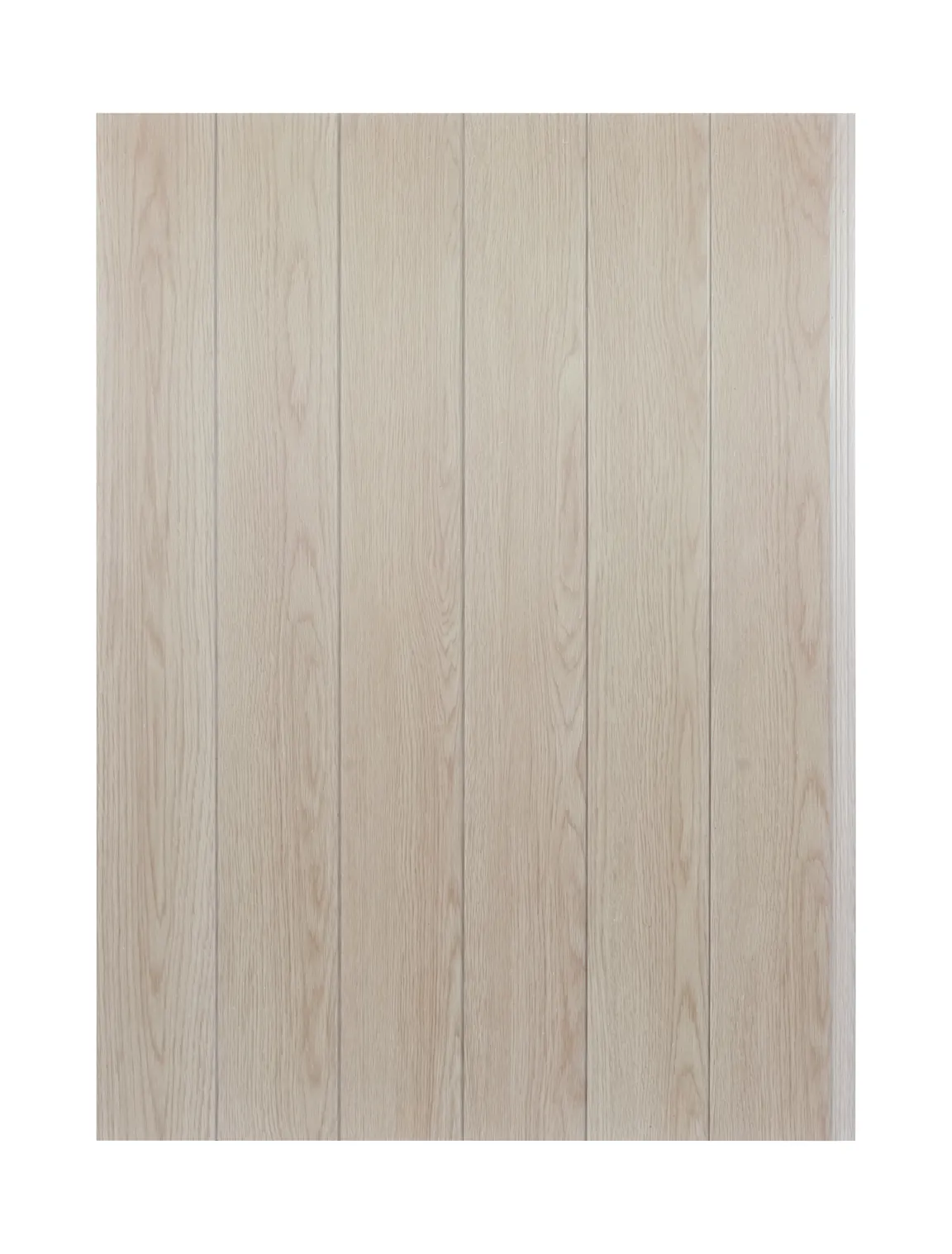
Pale Oak
The lightest, lowest-contrast tone in the range. It lets the joints, the shadow lines and the window frames do the drawing.
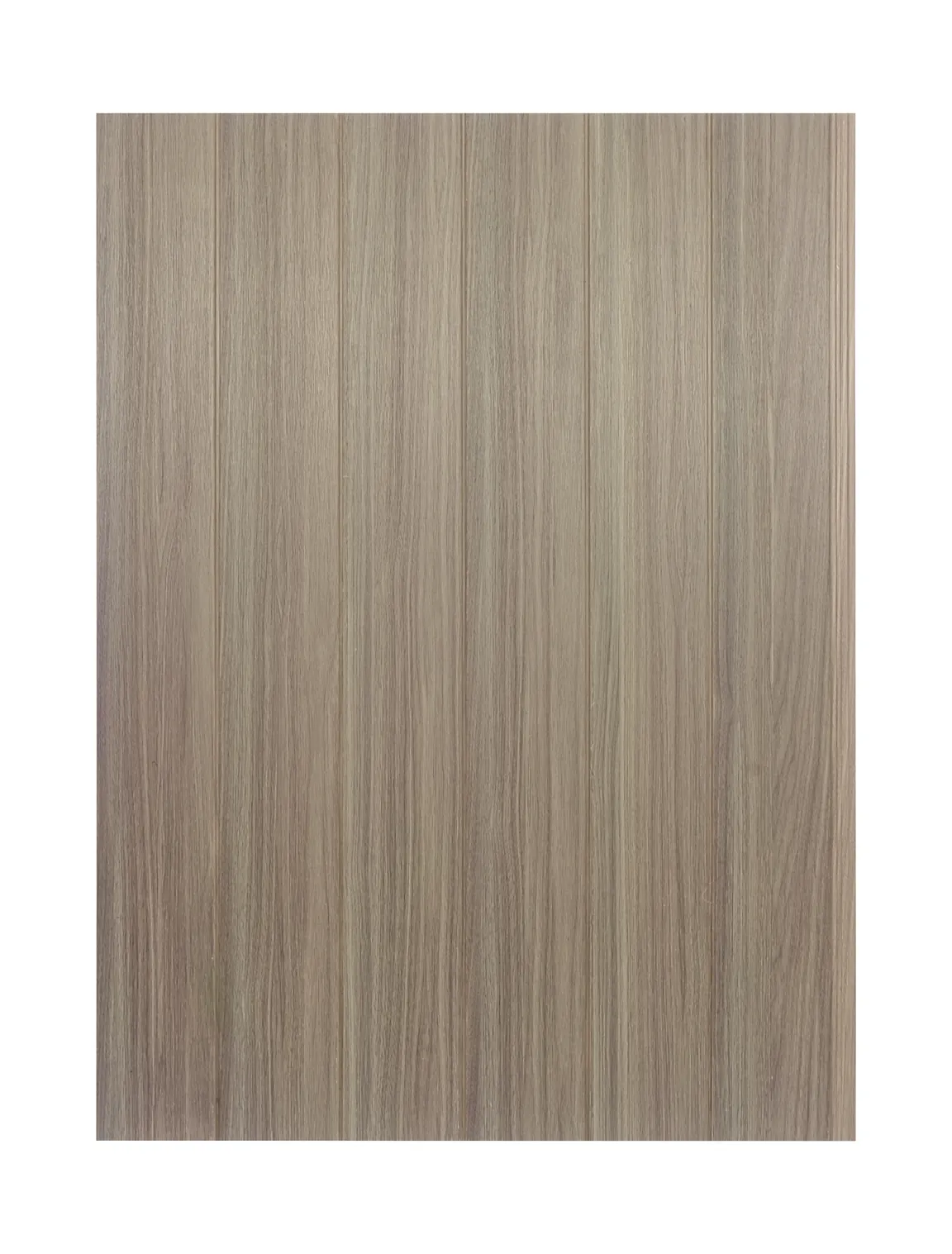
Ash Silver
The grey of weathered timber, with a silver sheen in the grain rather than a flat painted grey.
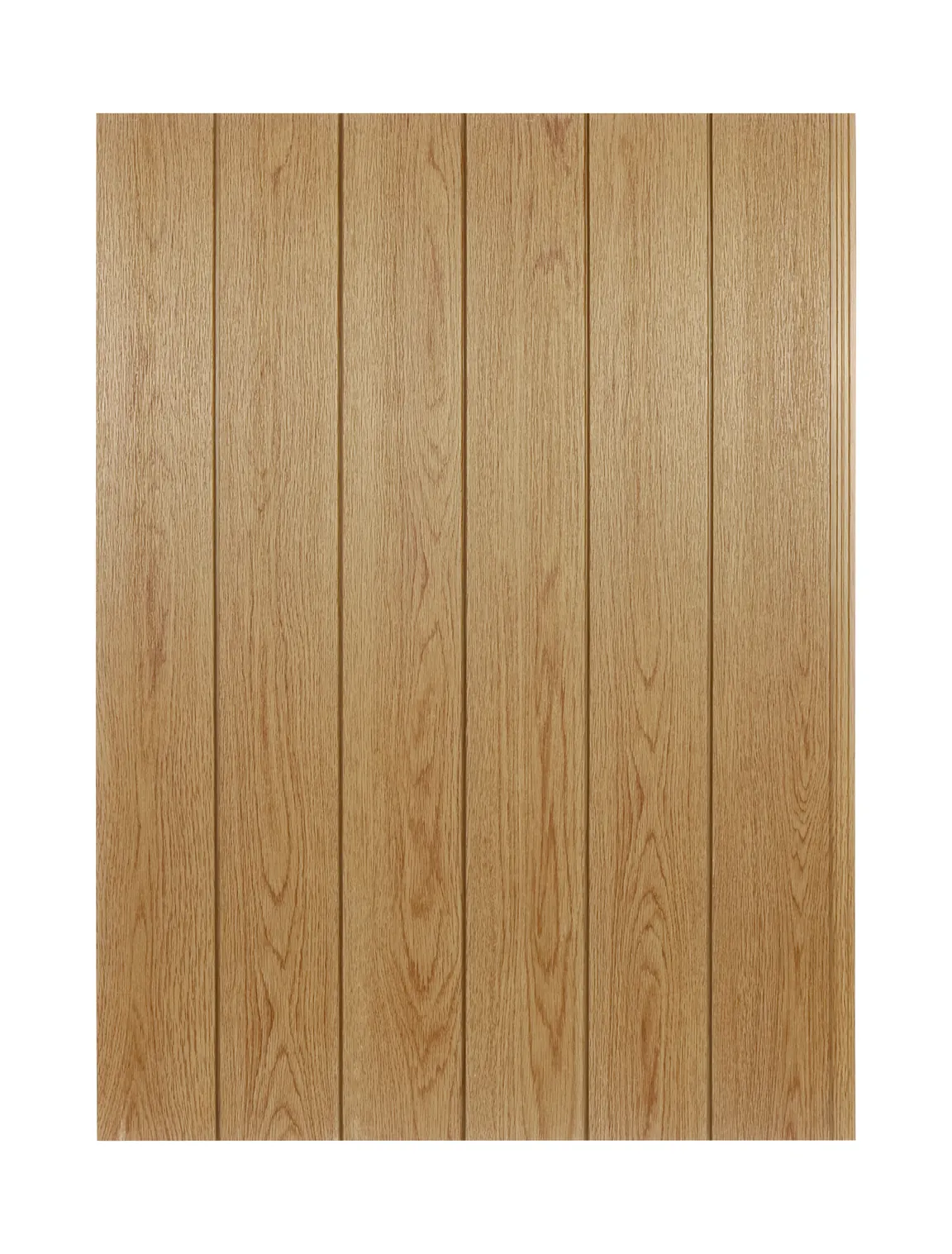
Golden Beech
The highest chroma of the light tones. The tone that reads closest to freshly oiled hardwood.
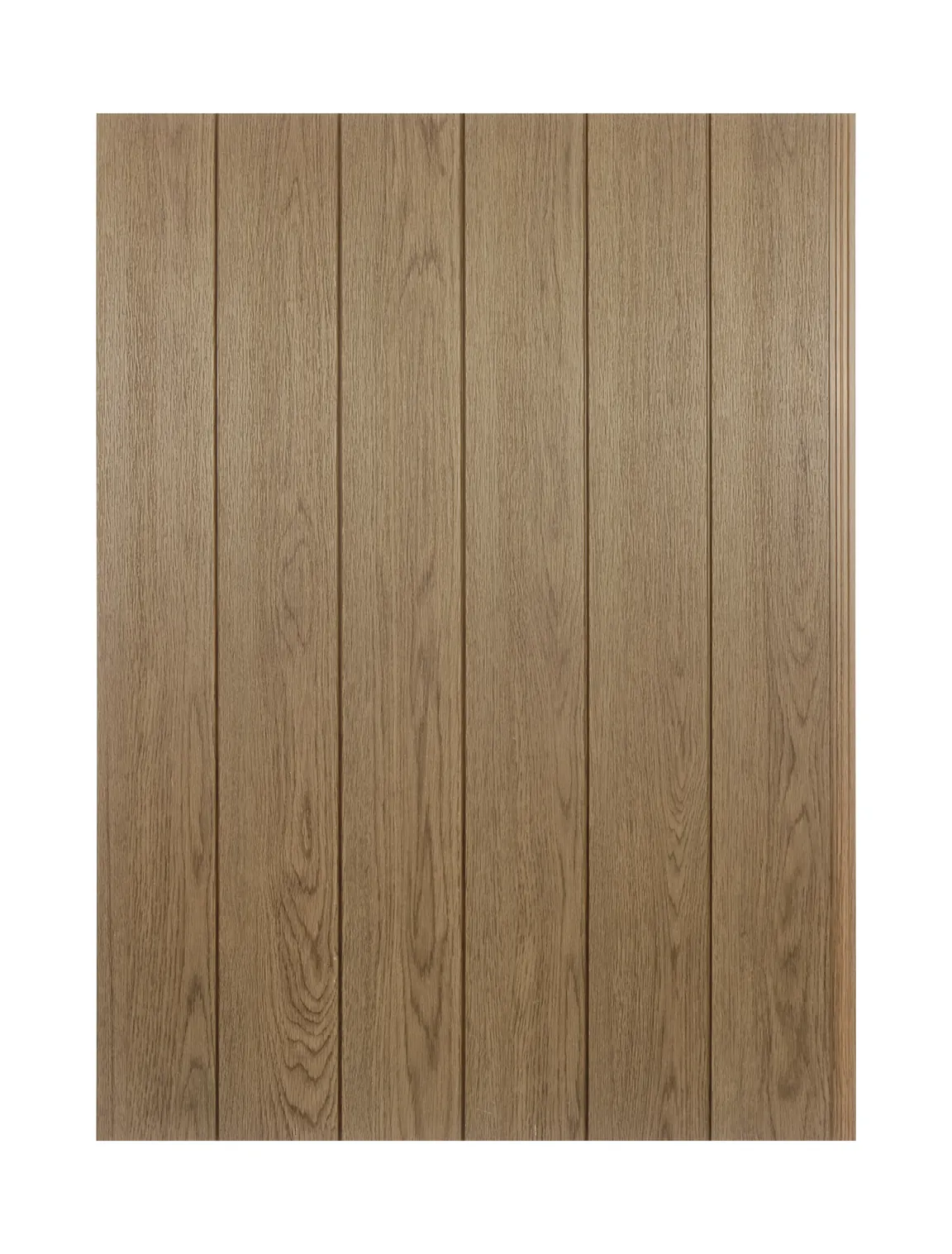
Honey Teak
The reference tone of the range and the most widely specified. Even figure, mid-dark pore lines, teak-scale.
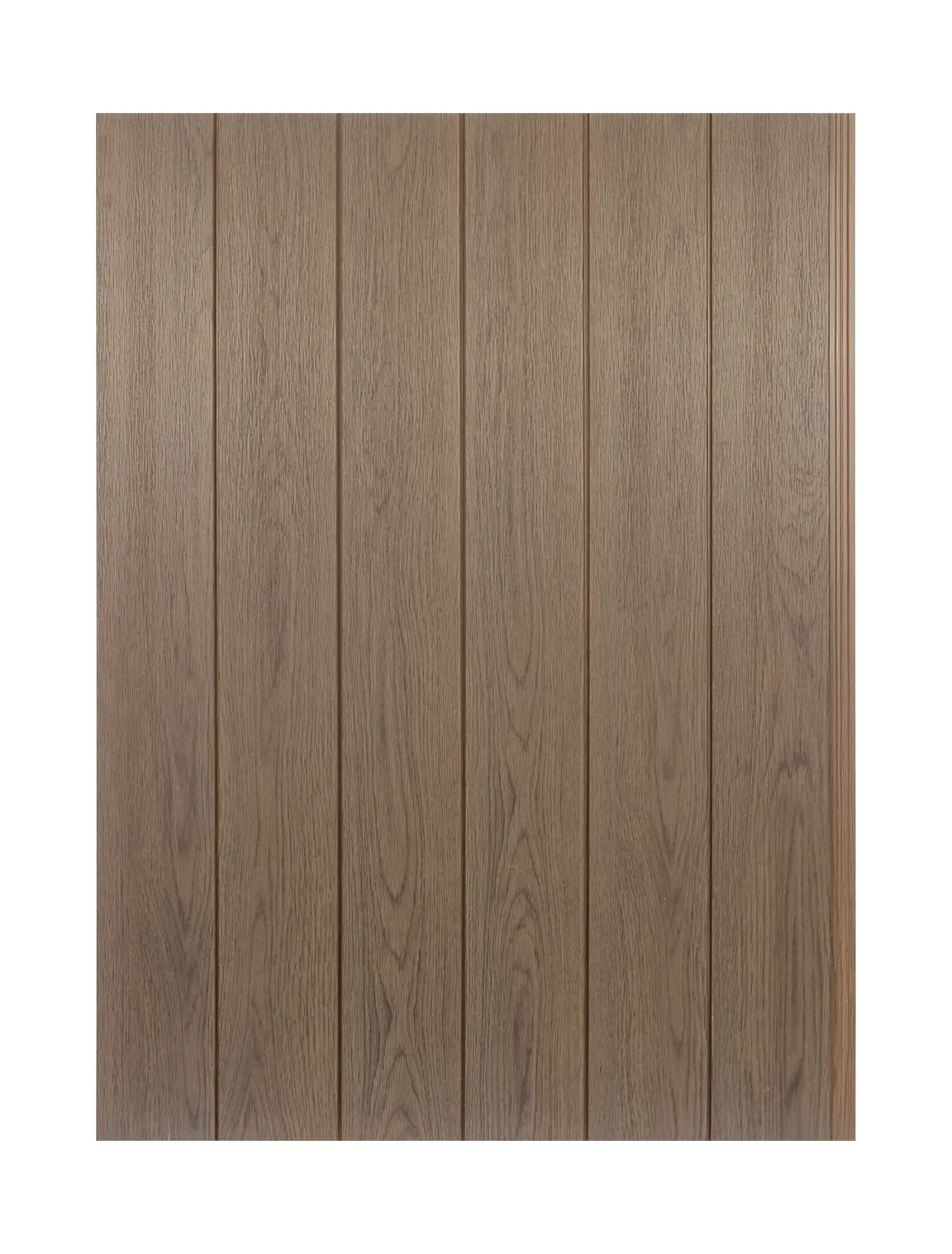
Smoke Grey
A greige rather than a cold grey — the tone that lets composite cladding sit next to concrete and render without arguing with them.

Coffee Walnut
The darkest and highest-contrast tone. Light grain on a dark ground, so the figure reads close up and the mass reads at distance.
Two questions decide it.
Almost every colour that goes wrong on a project was chosen on a sample at arm's length. These are the two questions that should be answered before the sample arrives, and the colour pages exist so you can answer them without one.
How dark do you want the wall to be?
This is the decision that changes the building. The six tones run continuously from Pale Oak, which blocks as a flat pale field at twenty metres, to Coffee Walnut, which blocks as a deep field and swallows the joints, the reveals and the shadow lines. Between them, Ash Silver and Golden Beech sit in the upper-middle band; Honey Teak and Smoke Grey in the middle.
The mistake that costs the most is judging a tone on a sample at arm's length. At arm's length the six look like six wood grains. At twenty metres they look like four different walls: pale, mid-light, mid-dark and dark. Look at the samples across a room before you look at them in your hand, and look at the colour pages for the two tones either side of the one you are considering.
Is the light around the building warm or cool?
The second question decides which of two similar-looking tones you should take. A low-chroma board takes its reading from its neighbours: pale render, brick and warm stone pull a grey toward cool, while blue-grey walls, zinc and glass pull a cream toward warm. That is perception rather than a product property, and it applies to real timber just as much.
Practically: if the elevation faces the sea or the sky, the cooler tones hold their character and the warm ones can pick up orange in low light. If it faces a warm render or a brick neighbour, the warm tones settle and the cool greys can look slightly clinical. If the light is flat and grey for most of the year, the mid-tones carry more than either end of the range.
The range groups into two working sets.
It is not a warm-to-cool gradient; it is two groups with different jobs. Warm boards read as timber and ask to be looked at. Neutral boards hand the elevation over to the architecture and ask not to be.
The warm group
Warm-toned boards read as timber and are the reason most clients ask for a wood-effect cladding in the first place. They carry a gable end, an upper floor or a whole elevation above a light base, and they hold their warmth in the deep shade of a canopy better than the cooler tones do. The trade-off is response: they move with the colour of the light, so a warm tone beside a large cool plane will read more orange than it does on a sample. Teak is the most recorded tone group in our project file, across ten markets.
The neutral group
Neutral boards hand the elevation over to the architecture. Pale Oak is the quietest - the joints, the shadow lines and the window frames become the pattern and a single dark element carries the facade. Ash Silver is the silvered-timber grey, the lowest-chroma tone in the range and the one that changes most between sun and overcast. Smoke Grey is the warm greige that sits beside concrete and render without the joint turning into a colour event. All three are specified where the cladding should not be the subject.
Choosing between two close tones.
Three pairs cause most of the hesitation. None of them are decided by a photograph.
Ash Silver vs Smoke Grey
The two greys are not interchangeable and they are the pair on which the physical sample matters most. Ash Silver is cooler, lighter and carries a silver sheen in the grain; Smoke Grey is a warmer greige, two steps darker, with a visible brown undertone. Straight on, on a screen, they can look similar. At an angle, in sunlight, they separate immediately. On a wall facing the sea or the sky, Ash Silver; against concrete or warm render, Smoke Grey.
Golden Beech vs Honey Teak
Same family, one step apart. Golden Beech is lighter and more saturated and matches freshly oiled hardwood; Honey Teak is browner and deeper and is the more common specification of the two. On a large elevation in strong light the difference is obvious; across two buildings photographed a week apart it is not, which is why the sample decides rather than the photograph.
Honey Teak vs Coffee Walnut
Not adjacent - a step and a half apart in value and turned toward red. Choosing between them is choosing whether the facade is light or dark, not choosing a shade. If you are building a two-tone scheme, this is the pair that gives the strongest contrast in the range; Pale Oak above Coffee Walnut is the hardest contrast available.
Where each tone family is already specified.
The project file records the profile and the market for every job; it does not record the pigmentation code. So the table below is grouped by tone family - teak, walnut, oak, grey and antique white - and it is not a claim that any of these installations used FV01 or FV02. The photographs behind it are of the MexyTech co-extruded wall system that FV01 and FV02 are engineered on. Read it as a record of where each tone family has been specified, which is what it actually is.
| Market | Tone family | What the project file records |
|---|---|---|
| SerbiaEurope | TeakGolden Beech Honey Teak | Teak co-extruded wall cladding, several project sets, one of them teak + walnut two-tone |
| CanadaNorth America | SP-WP11 and SP-WP08 teak cladding | |
| United StatesNorth America | SP-WP14 + SP-WP03 teak, wall cladding and exterior ceiling | |
| New ZealandOceania | SP-WP14 teak | |
| BelgiumEurope | SP-WP14 teak | |
| BahrainMiddle East | SP-WP03 teak | |
| EgyptAfrica | SP-WP11 teak and a first-generation WP03 set | |
| BrazilSouth America | SP-WP12 teak | |
| PhilippinesSoutheast Asia | WP03 teak | |
| Taiwan, ChinaEast Asia | SP-WP03 teak | |
| BulgariaEurope | WalnutCoffee Walnut | Walnut co-extruded wall cladding, 2021 |
| CanadaNorth America | SP-WP14 custom walnut, and SP-WP14 walnut | |
| SerbiaEurope | Teak + walnut two-tone wall cladding | |
| SingaporeSoutheast Asia | SP-WP14 walnut | |
| United StatesNorth America | WP03 coffee; SP-WP03 walnut in Hawaii | |
| Hong Kong, ChinaEast Asia | SP-WP11 and SP-WP14 walnut | |
| AustraliaOceania | SP-WP03 IPE, a dark brown of the same family | |
| AustraliaOceania | OakPale Oak | SP-WP08 oak cladding |
| NetherlandsEurope | SP-WP14 oak cladding | |
| AustraliaOceania | GreyAsh Silver Smoke Grey | Dark grey wall cladding, and SP-WP14 dark grey + IPE wall and deck |
| CanadaNorth America | SP-WP14 black with a custom walnut tone | |
| SerbiaEurope | Black wall cladding project set | |
| Costa RicaCentral America | Antique white / lightPale Oak Ash Silver | SP-WP03 in antique smoke white, the lightest tone in the file |
What is identical across all six.
Nothing in the specification below is conditional on which of the six you choose. The board, the surface system, the fixing, the minimum order and the warranty are the same in every colour; the only thing that changes is the surface tone. That is deliberate - it means a colour decision can be made late, and changed, without reopening anything else in the specification.
| Profiles | FV01 178 x 15 mm · FV02 223 x 25 mm |
|---|---|
| Exposed face | FV01 150 mm · FV02 195 mm |
| Construction | Fourth-generation WPC core with a composite ASA surface, cured together in the molecular crystal curing stage |
| Fixing | Patented pre-punched male end, screw-fixed to battens |
| Length | 2.9 m standard, custom within 3.0 m |
| Colours | Six standard colours, combinable in one container load |
| Warranty | 10 years, coverage scope subject to the formal warranty statement |
| Chain of custody | FSC® ESTS-COC-240458 |
| Fire | EN 13501-1 B-s3, d0 — tested on a 26 mm specimen, screw-fixed to a substrate, 40 mm ventilated cavity, no joint |
| UV / weathering | 3000 h QUA ageing report for the ASA surface, SDHL2407013318HI |
| Surface reference | The signed physical sample governs production, not any screen image |
Fire classification is quoted with its specimen build-up. FV01 is 15 mm and FV02 is 25 mm, and the classified specimen was 26 mm — confirm the required build-up against your project.
Questions buyers ask about the range.
The same answers we give by email. Where a claim comes from a test report rather than from us, it is labelled as such.
Will the delivered colour match the photo on this page?
No, and no supplier can promise that. Grain direction, the angle of the light and the production batch all shift what the eye reads, and a screen adds its own colour cast. Every colour is supplied as a physical section of the FV01 or FV02 profile you are specifying, and the approved sample is the reference production is held to.
Is the colour a coating that can peel off?
No. The composite ASA surface and the wood grain are cured together in the molecular crystal curing stage rather than applied as a printed film or a laminate, so there is no decorative layer to lift at an edge.
Does it fade or grey off the way timber does?
ASA is chosen for facades because it holds colour under UV. The 3000 h QUA ageing report for the ASA surface is SDHL2407013318HI. Colour retention is projected to exceed 20 years of outdoor exposure — a test-based estimate, not a warranty period. The commercial warranty is issued separately and is shorter by design: 10 years.
Is it fire tested?
EN 13501-1 B-s3, d0 was classified for a 26 mm specimen, screw-fixed to a substrate, with a 40 mm ventilated cavity and no joint between specimens. The classification applies to that specimen build-up; FV01 is 15 mm and FV02 is 25 mm, so use the tested build-up as the reference and confirm the requirement against your project.
Can I order a colour that is not one of the six?
Yes, as a custom colour, quoted case by case. Custom colours, custom grain patterns and custom lengths must be confirmed before the production schedule is fixed. Standard colours run on a 30-day lead time after order confirmation.
What is the minimum order?
Half a container per colour. The six standard colours can be combined within one container load, but each colour ordered has to meet its own minimum.
How should I compare two of the six?
Order sections of the actual profile and put them edge to edge in the same light, rather than comparing two photographs. The six-colour comparison image on this page is a photograph of six real sections, taken in one lighting setup, for exactly that reason.
Order the samples before you narrow it down.
Every colour is supplied as a physical section of the FV01 or FV02 profile you are specifying, cut from production board rather than cast as a colour chip. The sample is what production is held to — not this page, and not any render on it. Tell us the profile, the quantity, the market and the two or three tones you are choosing between, and we will come back with the samples, the lead time and the loading.
- MOQ
- Half a container per colour
- Lead time
- 30 days after order confirmation, standard colours
- Combining
- All six can share one container load

Six real sections, one lighting setup. This is the only honest way to compare two tones: edge to edge, in the light they will actually be seen in.