

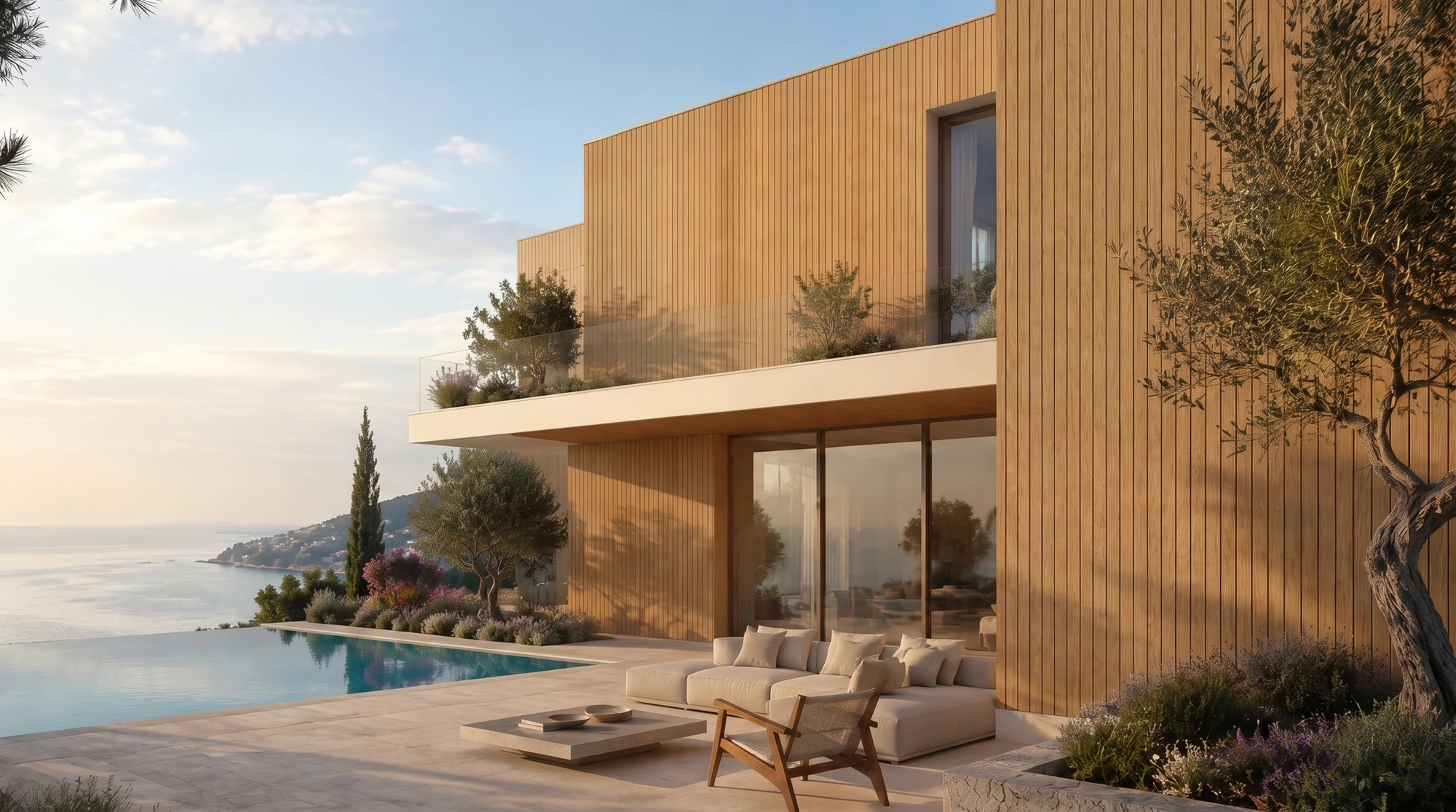
This guide is written for importers, architects, and contractors who specify exterior wall cladding. It covers the seven failures that generate the most owner complaints and warranty claims across vinyl, fiber cement, wood, and first-generation WPC cladding. For each failure we explain the mechanism, the question to ask a supplier, and the data FlowVeins holds from its own SGS test reports. The failure patterns come from published owner reviews and industry sources; the product data comes from third-party laboratory testing, with report numbers you can request and check.
Why exterior cladding fails: the short answer
Four mechanisms cause nearly every facade complaint:
- UV radiation degrades unprotected surfaces. Colors fade, and sun-facing boards fade faster than shaded ones.
- Water enters the material. Boards swell, mold grows, laminated panels delaminate.
- Heat softens some materials and moves all of them. Vinyl warps; boards installed without expansion gaps buckle.
- Impact cracks brittle materials. Fiber cement chips; cold vinyl shatters.
A fifth factor turns these into recurring cost: maintenance burden. A material that needs repainting every few years fails on the year the repainting does not happen. The material you specify decides which of these problems you manage on site and which ones you eliminate at the factory.
The 7 failure modes
1. UV fading and one-sided color difference
Ultraviolet radiation breaks down lignin in wood fiber and degrades surface pigments. First-generation WPC has wood fiber exposed at the surface, so the south- and west-facing boards on a facade bleach faster than the shaded ones, and within 18 to 24 months the wall shows a visible checkerboard. One WPC fencing maker estimates that color-fade complaints account for 30 to 40 percent of warranty claims on first-generation WPC products. Vinyl siding fades too, and many vinyl color warranties carry exclusions that limit the payout.
What to ask a supplier: an accelerated weathering report to ASTM G154 or ISO 4892 with a measured color change (ΔE), not a brochure claim.
FlowVeins data: a 3,000-hour ASTM G154 aging test measured a color change of ΔE*ab 2.7 with a grey scale rating of 4 (SGS report SDHL2407013318HI). The ASA cap layer contains no wood fiber, so there is no lignin at the surface to break down.
2. Heat distortion: warped and melted vinyl
PVC vinyl siding softens at comparatively low temperatures. Homeowners have documented vinyl warping where a neighbor’s low-emissivity window concentrates reflected sunlight onto the wall, and melting where a grill stands too close. The failure is cosmetic but permanent, and the panel has to be replaced.
What to ask a supplier: the heat deflection temperature of the material.
WPC cladding uses a wood-fiber-reinforced polymer core that keeps its shape at the surface temperatures that distort vinyl. It is a different material class, not a thicker version of the same one.
3. Water absorption: swelling, mold, and the failing bottom course
Water wicks into any wood fiber it can reach. On uncapped WPC, the bottom course of a wall, the splash zone, is where swelling and mold appear first; industry case reports describe uncapped boards swelling within about eight months of installation. Laminated panel siding fails differently and worse: once water reaches the core, the face delaminates and the whole panel must come off the wall.
What to ask a supplier: 24-hour soak water absorption and thickness swell, tested to ASTM D1037 or EN 317.
FlowVeins data: 1.8% water absorption and 0% thickness swell after a 24-hour soak (ASTM D1037, SGS report SDHL2408014917HI). The profile is solid co-extruded material with no laminated layers that can separate.
4. Impact cracking and brittle failure
Fiber cement cracks and chips on impact from ladders, hail, and lawn equipment, and a patched board stays visible. Vinyl grows brittle in cold weather and cracks from impacts it would survive in summer. Both failures anchor long homeowner-forum threads because repair means replacing whole boards, sometimes whole elevations.
What to ask a supplier: flexural strength after conditioning, not only at room temperature.
FlowVeins data: 28.3 MPa flexural strength measured after freeze-thaw cycling (ASTM D7031, SGS report SDHL250601030601HI). WPC flexes under impact instead of shattering.
5. Repainting cycles and lifetime maintenance cost
Wood and cedar cladding needs retreatment every 4 to 9 years depending on exposure. Fiber cement holds its factory finish longer, then joins the same repainting cycle. The material line on the invoice is rarely the expensive part; scaffolding and labor are. An owner who skips one cycle accelerates every other failure on this list.
What to ask a supplier: the 10-year total cost of ownership, including recoating labor, not the ex-factory price.
Co-extruded WPC cladding is never painted or sealed. Maintenance is washing with water. FlowVeins product documentation lists a 10-year warranty.
6. Warping from thermal movement
Every cladding material expands and contracts with temperature. Many failures blamed on the material are installation failures: boards pinned tight with no expansion allowance buckle, closing gaps crush cut ends, and over-spanned battens let boards bow between fixings.
What to ask a supplier: a published installation guide with expansion gaps, batten spacing, and fixing details. If a supplier cannot show one, the material data matters less than it looks.
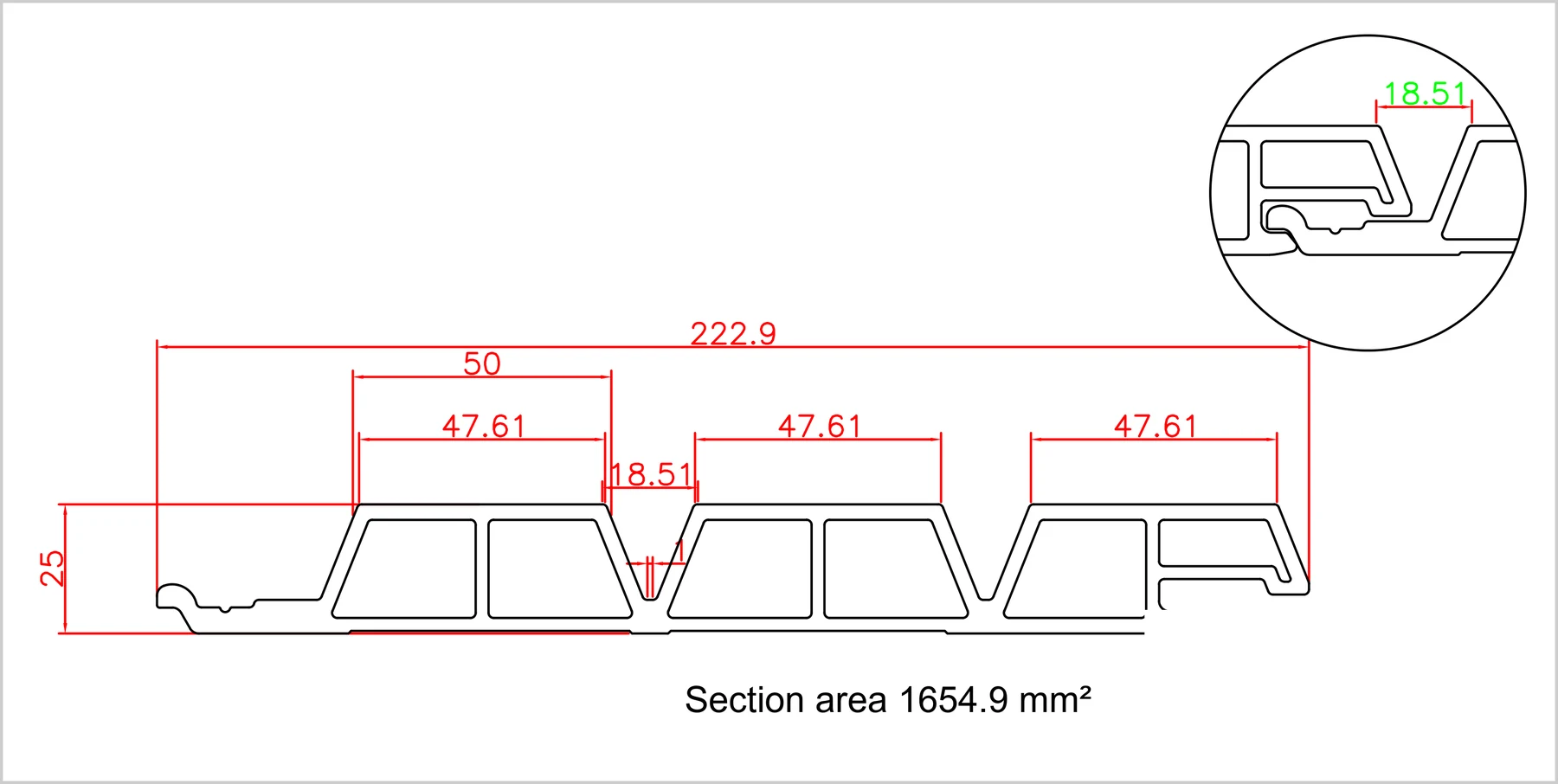
FlowVeins FV02 panels are pre-punched at the male end, so the fixing position and the expansion allowance are controlled by the panel itself rather than left to the installer to guess.
7. The plastic look
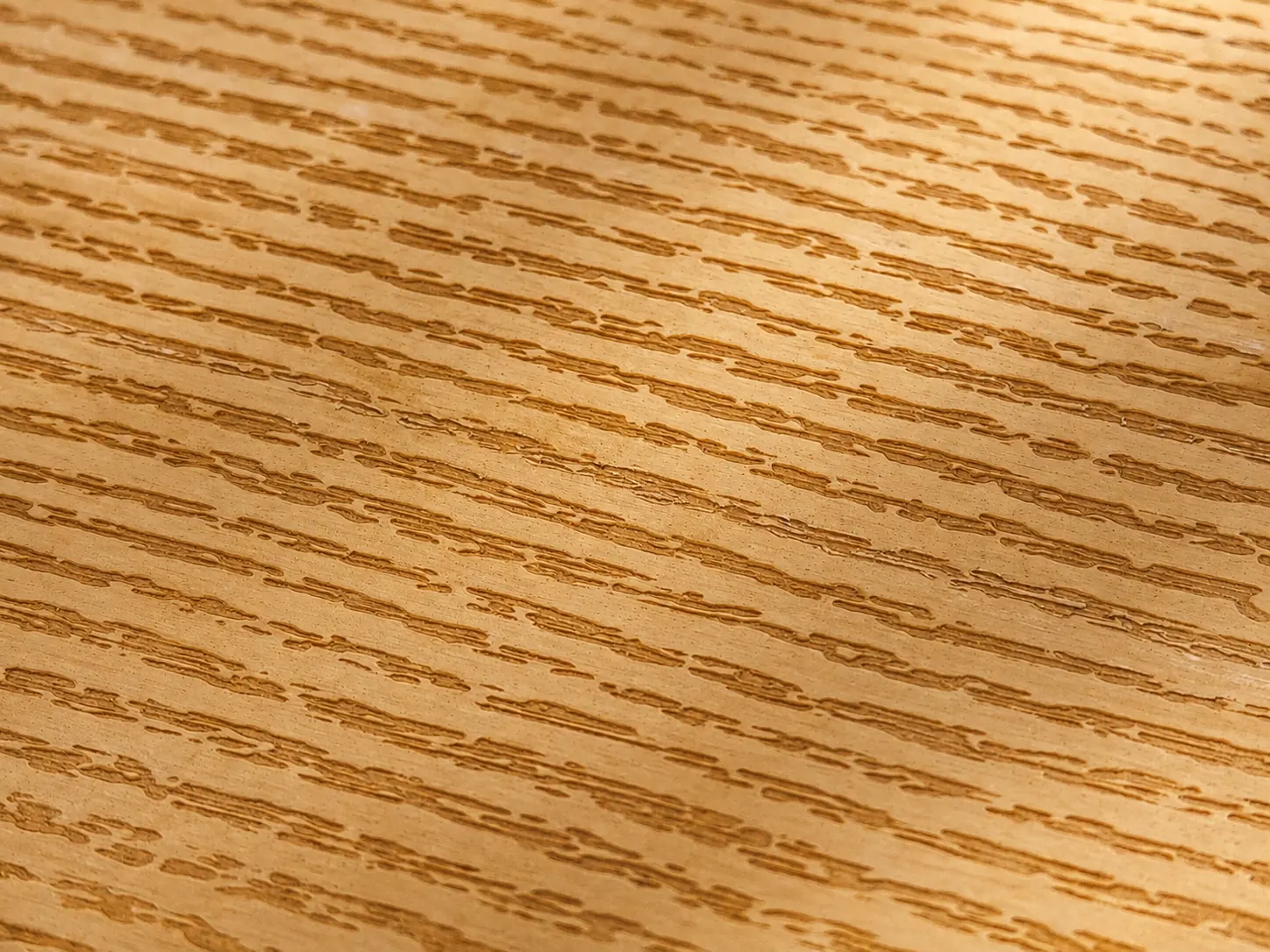
Embossed vinyl and smooth-surface composites read as plastic from the street. Owners reviewing composite products land on the same sentence again and again: looks fine, but not like wood. Texture is a specification item, not a taste issue, because it decides whether the facade photographs like timber or like sheet goods.
FlowVeins panels carry the brushed texture, a deep grain molded into the ASA cap. Judge it from the close-up, not from a rendering.
Failure risk by material at a glance
| Failure risk | Vinyl (PVC) | Fiber cement | Wood / cedar | 1st-gen WPC | Co-extruded WPC |
|---|---|---|---|---|---|
| UV fading | High | Low (paint ages first) | High | High | Low: ΔE 2.7 after 3,000 h |
| Heat distortion | High: softens, melts | Low | Low | Low | Low |
| Water absorption, mold | Low | Medium | High | High when uncapped | Low: 1.8%, 0% swell |
| Impact cracking | High when cold | High | Low | Low | Low: 28.3 MPa after freeze-thaw |
| Repainting cycle | None | Yes | Every 4–9 years | None | None |
| Weight and handling | Light | Heavy boards | Medium | Medium | Medium |
No column is all green. Fiber cement wins on heat and fire; it loses on weight, impact, and repainting. Wood wins on repairability; it loses on every row that needs maintenance. The useful question for a project is which failures you can afford to manage.
What co-extrusion changes
First-generation WPC is one material all the way through: wood fiber and polymer mixed, extruded, done. Whatever the recipe, wood fiber sits at the surface, and the failure modes above follow from that.
Co-extrusion adds a second step in the same pass through the die: a cap layer of ASA, a weather-resistant engineering polymer, is extruded around the WPC core, so the finished profile has no wood fiber exposed anywhere on its surface. UV, water, and stains meet the cap, not the core.
FlowVeins adds a proprietary step it calls molecular crystal curing, which bonds the cap to the core and removes the layer boundary that can separate on ordinary co-extruded boards. MexyTech, the Foshan manufacturer behind FlowVeins, was the first producer in South China to master this bonding process, and it has made WPC products since 2009.
The FlowVeins test data
Every figure below comes from a third-party SGS report. Report numbers are listed so you can request the documents and check them. ASTM G154, the method behind the UV figure, is the standard accelerated weathering test: fluorescent UV lamps and condensation cycles compress years of outdoor exposure into thousands of laboratory hours.
| Property | Test method | Result | SGS report |
|---|---|---|---|
| UV aging | ASTM G154, 3,000 hours | ΔE*ab 2.7, grey scale 4 | SDHL2407013318HI |
| Water absorption | ASTM D1037, 24-hour soak | 1.8% absorption, 0% thickness swell | SDHL2408014917HI |
| Flexural strength | ASTM D7031, after freeze-thaw | 28.3 MPa | SDHL250601030601HI |
| Fire classification | EN 13501-1:2018 | B-s3, d0 | SDHL250200203201HI |
The wood fiber in the core is FSC-certified: chain-of-custody certificate ESTS-COC-240458, issued to Foshan MexyTech Co., Ltd. Certificate pages and the four SGS reports are published on the about page.

What different markets require before the board goes on the wall
Between 2023 and 2026 our field teams made thirteen market visits, covering Europe, the Middle East, Asia-Pacific, the Americas and Oceania. The first question was never about colour. It was what the local authority accepts, and which document proves it. Three patterns came back every time.
Fire class decides most specifications
The requirement changes by market, and the paperwork rarely travels with the product:
- Netherlands and Germany. Channel partners there specified new-build elevations at fire class B and accepted class D on renovation work. The same project can move up a class by changing the substructure rather than the board: one specification put cladding at D on timber battens and at C on aluminium battens.
- Italy. Large projects require fire classification issued by an Italian-accredited laboratory. A report from another country is not accepted, whatever it concludes.
- Japan. Public and government-linked projects likewise recognise domestic test reports only.
- United Kingdom and France. Exterior cladding is at an earlier stage than fencing in both markets and the entry barrier is higher, because the fire and structural paperwork is reviewed before the product itself.
- California. Wildland-urban interface zones require WUI fire approval, applied for per product model, submitted to CALFIRE with a fire report, and renewed every year.
- Florida. Hurricane zones require a Notice of Acceptance for cladding and fencing, signed off by a licensed engineer.
- Canada. Commercial facades need a fire-qualified product, and boards longer than 12 ft (3.66 m) need third-party certification if they are to be fixed without clips.
- Australia and New Zealand. Cladding in designated bushfire zones has to meet a bushfire attack level rating. The market has been led by fibre cement carrying structural certification.
The lesson is not that one class is better. It is that a fire classification is only valid for the assembly it was tested in. Our own EN 13501-1 classification states its end-use conditions outright: with a substrate, with mechanical fixing, and no joint between boards, tested with a 40 mm ventilated cavity behind the panel. Change the cavity, the fixing or the joint and the classification stops describing your wall, even though the board is identical.
So the question for any supplier is not what class your board is, but what class it is in my assembly, and can I read the end-use conditions on the report. FlowVeins holds EN 13501-1 B-s3, d0 under the conditions above, in SGS report SDHL250200203201HI. Where your build-up differs, ask us to state what that test does and does not cover before you rely on the class.
Climate decides which failure you get
The failure that produces the complaint is set by local weather, not by the material label:
- Gulf and desert markets. High ambient temperature with extreme UV. Colour retention and surface temperature decide the sale, and buyers ask for UV data before they look at samples.
- South-east Asia. Hot and humid all year. The recurring complaint is expansion and cracking, which is a fixing and gap problem more than a board problem.
- Eastern Canada. Winters at minus 20 °C, strong summer UV, and maritime humidity on the coasts, so freeze-thaw and UV resistance matter in the same wall. Our teams reported severe UV on the Atlantic islands.
- Northern and central Europe. Cold winters put the emphasis on freeze-thaw performance, and a short cladding season pushes buyers toward materials that need no annual work.
- Oceania and north-west Europe. High rainfall driven sideways against the wall, where the cavity, flashing and weather-resistive barrier matter more than the board surface.
- Mediterranean and island coasts. Salt, plus light reflected off water and glazing, which is a harsher exposure than direct sun on its own.
Read that list against the seven failure modes above and the pattern is simple. UV fading is a desert and high-altitude problem. Water, mould and delamination are a humid and coastal problem. Cracking is a hot-humid fixing problem. Freeze-thaw is a continental problem. Work out which one applies to your site before comparing boards, because a supplier optimising for a different one will look cheap and perform badly.
Three questions to put in your own tender
- Which fire class, in my build-up? Ask for the end-use conditions in writing, not only the class letter.
- What does the colour do by year five? Ask for the accelerated weathering result, the test hours and the report number, then have someone read the report.
- Who pays when it fails? Ask what the warranty covers and what it excludes, and whether it reaches the substrate, the fixing and the labour. A warranty covering the board alone is not covering the failure that costs money.
What FlowVeins cladding costs, and why it is not the cheapest board
Co-extruded ASA cladding is not the cheapest way to cover a wall. It costs more than PE-capped composite cladding of the same profile size, and more than vinyl siding. FlowVeins does not compete on the lowest line of a tender, and a supplier who claims otherwise is quoting a different board.
Three things sit in the price:
- The cap polymer. ASA costs more than the PE used on commodity composite cladding. It is the layer that carries the colour, so it is the one part of the board that cannot be cheapened without shortening the life of the facade.
- The bonding step. Molecular crystal curing bonds the cap to the core in the same extrusion pass, removing the layer boundary that separates on ordinary co-extruded boards.
- The test programme. Four third-party SGS reports, an FSC chain-of-custody certificate, and EN 13501-1 fire classification are paid for per profile, not per container.
Market context, from the manufacturer’s own channel research in Germany, France, Spain, Italy, Portugal and the UK: the volume product on external walls is PE-capped co-extruded cladding in a grooved profile, and much of it is bought on price alone. FlowVeins is built for the tier above it, for buyers who are quoting on finish and warranty rather than on the cheapest board that passes.
Compare total cost, not board cost
The board price is the smallest number in a facade budget held over 20 years. Recoating drives the rest. Timber cladding needs retreatment every 4 to 9 years, and on a two-storey elevation most of that invoice is scaffolding and labour, not coating. Fiber cement holds its factory finish longer and then joins the same cycle.
Work the comparison as: board cost per square metre, plus the number of recoating cycles over the hold period, multiplied by the cost of scaffolding, labour and coating per cycle. On most projects the second term decides which material is cheaper. Ask for both terms before choosing.
When FlowVeins is the wrong specification
- A budget-led project where the cheapest compliant board wins. That is a legitimate buying criterion; it is simply not this product.
- A wall that has to be non-combustible. FlowVeins is EN 13501-1 B-s3, d0: combustible, with limited smoke and no flaming droplets. Check the building class before anything else.
- Anywhere the cladding is expected to do the waterproofing. This is a rainscreen board; the cavity, flashing and weather-resistive barrier keep the wall dry.
Pricing is quoted per project, FOB Shenzhen, with a minimum of half a container per profile and colour. Send the elevation area and the target port for a quotation.
What co-extruded WPC does not fix
Claims without limits help no one. Four honest ones:
- Thermal movement still happens. WPC expands and contracts with temperature, so expansion gaps and correct fixing are mandatory. Skipping them warps any board, from any maker.
- Dark colors run warmer. In direct summer sun a dark facade gets hot to the touch, whatever the material. Lighter colors stay measurably cooler on high-sun walls.
- Cladding is not the waterproofing. A rainscreen cavity, flashing, and a weather-resistive barrier keep the wall dry; the cladding protects them and carries the appearance.
- First cost is higher than vinyl. The case for co-extruded WPC rests on service life and zero repainting, not on being the cheapest line on the quote.
Specification summary
FlowVeins is the exterior cladding brand of MexyTech, a WPC manufacturer in Foshan, China, established in 2009. Export terms are FOB Shenzhen. Full product details are on the product page.
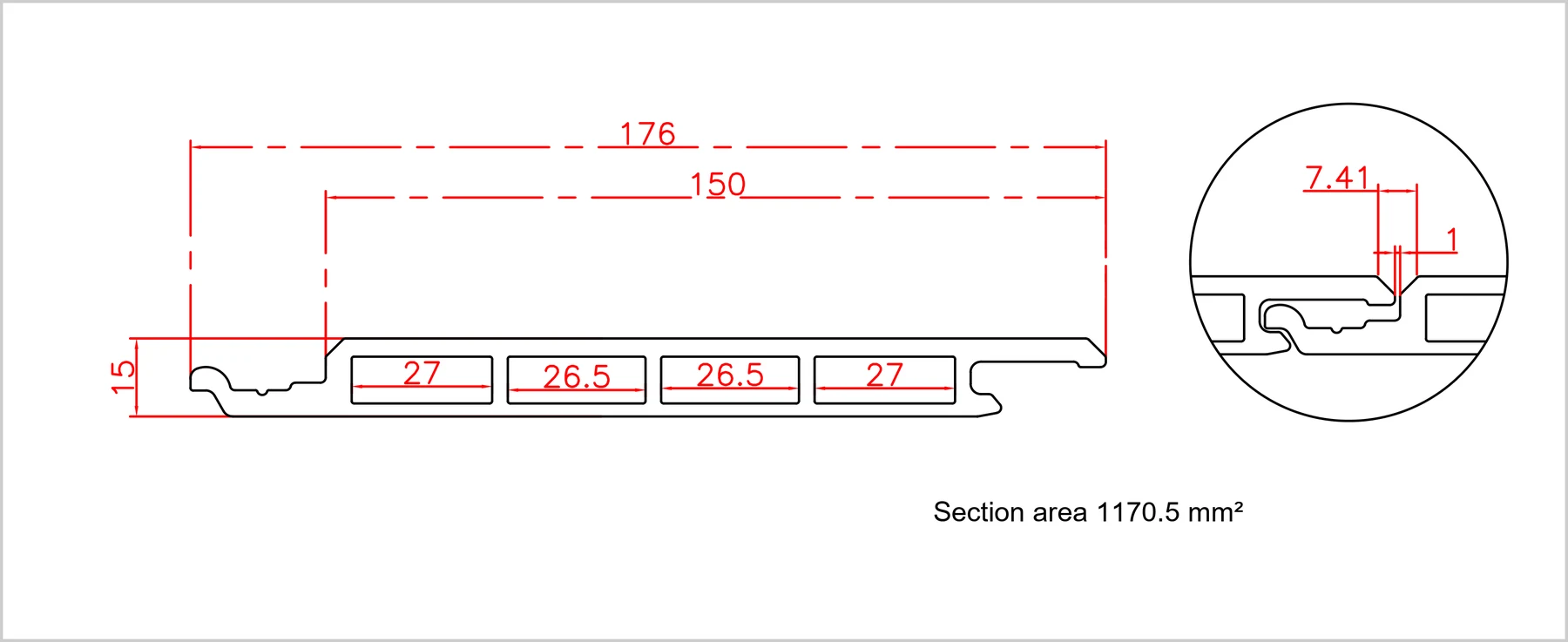
- Profiles: FV01 flat panel, 178 × 15 mm; FV02 slat-wall profile, 223 × 25 mm with pre-punched male end
- Length: 2.9 m standard; custom lengths on request
- Fixing: hidden clips and screws on joists at 300 to 400 mm centres
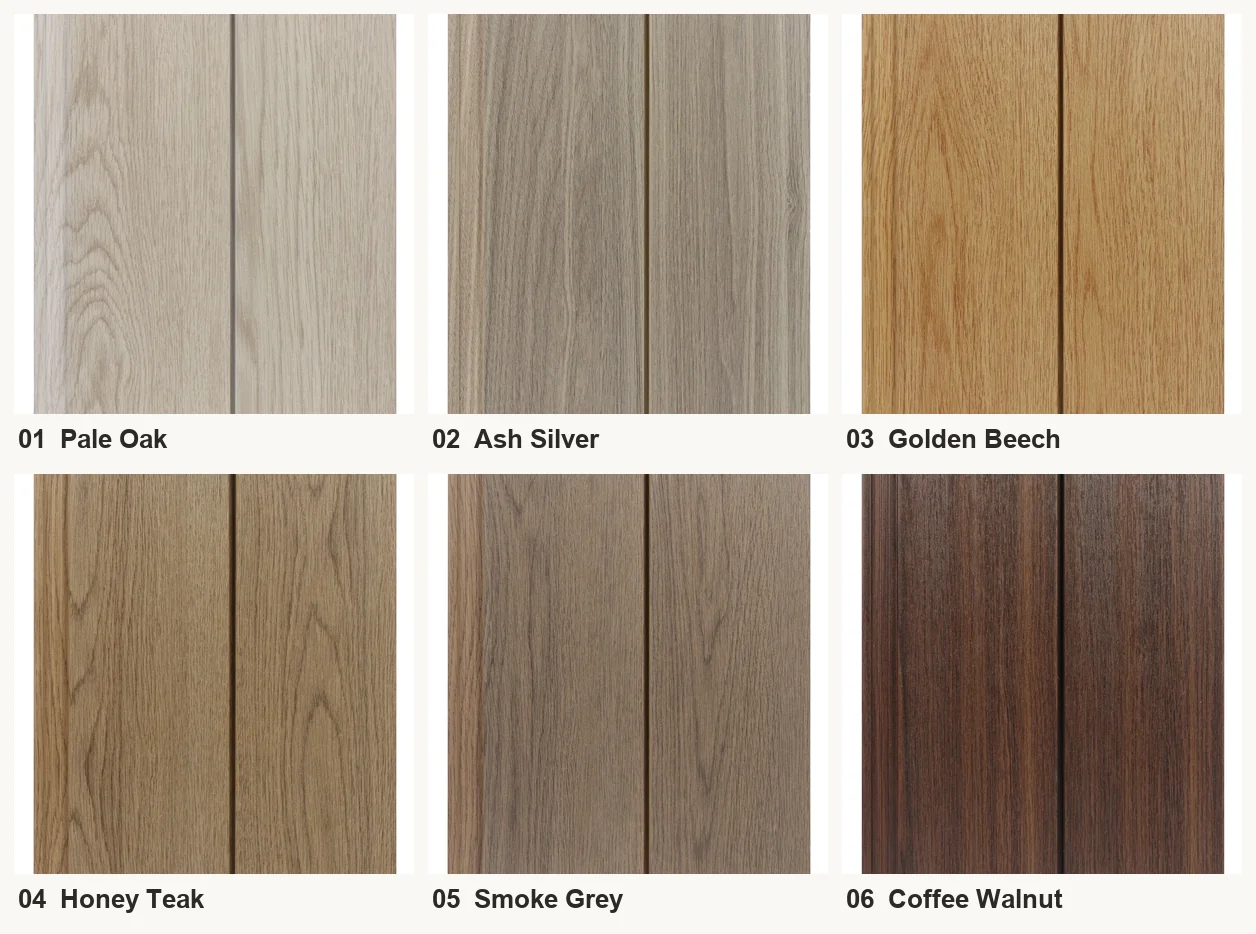
- Standard colors (6): Pale Oak, Ash Silver, Golden Beech, Honey Teak, Smoke Grey, Coffee Walnut
- MOQ: half a container per color; colors can be combined within one container load
- Warranty: 10 years, per product documentation
- Certificates: FSC ESTS-COC-240458; four SGS test reports as listed above

Frequently asked questions
Does composite cladding fade in the sun?
Every exterior material shifts slightly under UV; the useful question is by how much. First-generation WPC fades visibly within about two years on sun-facing walls. Co-extruded boards hold color far longer because the cap layer has no wood fiber. Ask any supplier for a ΔE figure from an ASTM G154 test. FlowVeins measured 2.7 after 3,000 hours.
Is WPC cladding better than fiber cement?
They trade different things. Fiber cement is non-combustible and cheap to buy; it is also heavy, cracks on impact, and needs repainting. WPC is lighter, flexes instead of cracking, and is never painted. On fire performance, FlowVeins cladding is classified EN 13501-1 B-s3, d0: combustible, with limited smoke and no flaming droplets. Check what your local code requires for the building class before deciding on this point alone.
Can I use WPC cladding where sunlight reflects off windows, or near a grill?
WPC keeps its shape at the surface temperatures that warp and melt vinyl, which is the material with the documented failures in these situations. Normal clearances between grills and any cladding still apply.
How long does co-extruded WPC cladding last?
FlowVeins lists a 10-year warranty. The accelerated aging and freeze-thaw data support a longer service expectation, but no honest supplier quotes a lifespan beyond its warranty terms.
Does WPC cladding need painting or sealing?
No. The ASA cap is the finished surface. Maintenance is washing with water.
What is the minimum order, and how is it shipped?
Half a container per color, with colors combined in one container load, FOB Shenzhen. Custom colors and custom grain patterns are quoted case by case.
FlowVeins sends the four SGS reports, the FSC certificate, and a project quotation on request. Contact the export team.